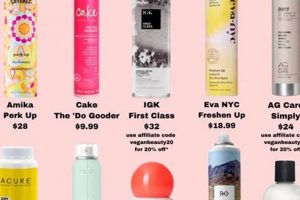
Hair care products formulated without any animal-derived ingredients and not tested on animals represent a growing sector in the personal care industry. These products aim to provide cleansing and conditioning benefits using plant-based or synthetic alternatives to traditional ingredients like honey, beeswax, and lanolin. An example is a shampoo containing coconut-derived surfactants for cleansing and a conditioner using shea butter for moisturizing.
The rising demand for cruelty-free and environmentally conscious options fuels the significance of these formulations. They offer consumers a way to align their purchasing decisions with ethical values and potentially reduce their environmental footprint. Historically, the prevalence of animal-derived ingredients in cosmetics was commonplace; however, increasing awareness and advocacy have driven innovation and the development of effective vegan alternatives.
The following sections will explore the criteria for evaluating these products, including ingredient analysis, performance assessment, environmental impact considerations, and popular brands currently available on the market. The information will allow readers to make informed decisions regarding the selection of suitable hair care solutions.
Selecting Effective Plant-Based Hair Care
Achieving optimal results with plant-based hair care requires careful consideration. The following recommendations can help to ensure efficacy and satisfaction.
Tip 1: Examine the Ingredient List. Scrutinize product labels for the presence of potentially harmful or non-vegan components. Avoid sulfates, parabens, and silicones, opting instead for natural oils and plant-based extracts.
Tip 2: Identify Hair Type Needs. Different hair types (e.g., oily, dry, fine, thick) require specific formulations. Select products specifically designed to address the unique characteristics of the individual’s hair.
Tip 3: Consider Scalp Sensitivity. Individuals with sensitive scalps should choose hypoallergenic and fragrance-free options to minimize the risk of irritation.
Tip 4: Prioritize Sustainable Packaging. Opt for brands committed to environmentally friendly packaging, such as recyclable bottles or minimal packaging materials.
Tip 5: Research Brand Reputation. Investigate a brand’s ethical stance, including its commitment to cruelty-free practices and sustainable sourcing.
Tip 6: Observe Product Performance Over Time. Evaluate the long-term effects on hair health. Consistent use should result in improved shine, manageability, and overall condition.
Following these recommendations allows consumers to make well-informed choices and achieve the desired outcomes from their hair care routine. Choosing suitable products contributes to both personal well-being and environmental responsibility.
The subsequent sections will delve into specific product recommendations and further elaborate on the benefits of adopting a plant-based hair care regimen.
1. Ingredient Transparency

Ingredient transparency is a cornerstone of plant-based hair care. The absence of animal-derived ingredients is a key consideration; however, consumers increasingly demand clear and comprehensive information about all components. This includes the origin of ingredients, their manufacturing processes, and potential environmental impacts. Without this transparency, verifying a product’s true adherence to vegan principles and ethical sourcing becomes exceedingly difficult. Mislabeling or incomplete ingredient lists can mislead consumers seeking cruelty-free and sustainable alternatives. The correlation is that to evaluate best vegan shampoo and conditioner require ingredient transperancy to trust product’s purpose.
For example, some products may claim to be vegan but contain derivatives of palm oil, which, despite being plant-derived, is often linked to deforestation and habitat destruction impacting animal populations. Similarly, vague terms like “fragrance” can mask the presence of animal-derived musks or synthetic chemicals with potentially harmful effects. Brands committed to transparency provide full disclosure of ingredient lists, including common names and scientific names, along with information about their sourcing practices. This builds trust and enables consumers to make informed decisions aligned with their values.
In conclusion, ingredient transparency is inextricably linked to the perceived quality and ethical standing of any plant-based hair care product. It empowers consumers to verify claims, supports responsible manufacturing practices, and promotes a more sustainable and ethical approach to the personal care industry. Lack of transparency undermines the very principles upon which the vegan movement is based, making it essential for any product aspiring to be considered the best.
2. Sustainable Sourcing
Sustainable sourcing forms a critical component in defining plant-based hair care. It extends beyond merely avoiding animal products to encompass the environmental and ethical considerations surrounding the acquisition of all ingredients. This emphasis directly impacts the overall value and integrity of such hair care products, influencing their perceived quality and ethical standing.
- Ethical Labor Practices
Sustainable sourcing requires adherence to fair labor standards throughout the supply chain. This includes ensuring safe working conditions, fair wages, and the absence of child labor in the cultivation and harvesting of plant-based ingredients. For example, shea butter sourced from cooperatives that empower women in West Africa contributes positively to both the product and the communities involved. Failure to uphold ethical labor practices undermines the ethical claims and, consequently, the value of any hair care product.
- Biodiversity Preservation
The sourcing of plant-based ingredients must prioritize the preservation of biodiversity. Unsustainable harvesting practices can lead to habitat destruction and species endangerment, negating the benefits of using plant-derived ingredients. For example, using sustainably harvested argan oil from Morocco, where harvesting practices support the preservation of the argan forest ecosystem, is a positive aspect. Products that contribute to deforestation or monoculture farming practices contradict the principles of environmental responsibility.
- Resource Management
Sustainable sourcing necessitates responsible management of natural resources, including water and energy. Ingredients requiring excessive water consumption or energy-intensive processing methods detract from a product’s overall sustainability profile. For instance, opting for ingredients that can be grown with minimal water usage or that utilize renewable energy sources in their processing contributes to a smaller environmental footprint. Brands should actively seek out suppliers committed to resource conservation.
- Traceability and Transparency
Full traceability of ingredients, from origin to final product, is essential for verifying sustainable sourcing practices. This transparency allows consumers to make informed choices and hold brands accountable for their environmental and ethical commitments. Traceability systems that track the origin of ingredients, processing methods, and labor conditions build trust and reinforce the integrity of the product. Without traceability, claims of sustainability become difficult to substantiate.
In summary, sustainable sourcing encompasses a multifaceted approach to ingredient acquisition, prioritizing ethical labor practices, biodiversity preservation, resource management, and traceability. By adhering to these principles, brands can deliver hair care products that are not only free from animal-derived ingredients but also contribute to a more sustainable and equitable world, enhancing their claim as products that are “best vegan shampoo and conditioner”.
3. Performance Efficacy
Performance efficacy directly influences the perceived quality and consumer satisfaction of plant-based hair care. The absence of animal-derived ingredients cannot compensate for inadequate cleansing, conditioning, or styling capabilities. A plant-based shampoo failing to effectively remove dirt and oil, or a conditioner that leaves hair dry and unmanageable, will not be considered a viable alternative to conventional products, irrespective of its vegan status. Real-life examples abound: a shampoo using gentle, plant-derived surfactants might boast a vegan label but, if it leaves residue or causes scalp irritation, it fails in practical application. Similarly, a conditioner relying on natural oils might lack the detangling properties offered by silicones, leading to dissatisfaction among users with coarse or easily tangled hair.
The evaluation of performance efficacy necessitates considering diverse hair types and their specific needs. A product excelling on fine, straight hair might prove unsuitable for thick, curly hair, and vice versa. Furthermore, factors such as climate, water hardness, and individual styling habits influence the effectiveness of hair care products. Manufacturers must therefore formulate products that address a broad spectrum of requirements, using plant-based ingredients that replicate or surpass the performance of their animal-derived counterparts. Innovation in plant-based chemistry plays a crucial role in bridging this gap, enabling the development of high-performing vegan formulations.
Ultimately, performance efficacy is non-negotiable. While ethical considerations drive the demand for plant-based options, sustained adoption hinges on demonstrable results. Brands seeking to establish their products as superior alternatives must prioritize the development of formulations that deliver tangible benefits, meeting or exceeding the standards set by conventional hair care. Only by achieving this can “best vegan shampoo and conditioner” claim to offer a truly compelling and lasting value proposition.
4. Cruelty-Free Certification

Cruelty-Free Certification serves as a crucial validation mechanism for hair care products marketed as plant-based. It provides assurance to consumers that no animal testing was conducted during the product’s development or manufacturing, aligning with the ethical considerations often associated with plant-based choices. The presence or absence of such certification directly impacts the perceived value and trustworthiness of any claim to be the “best vegan shampoo and conditioner.”
- Third-Party Verification
Independent organizations such as Leaping Bunny and PETA provide cruelty-free certification following rigorous audits of manufacturers and suppliers. These audits verify that no animal testing occurs at any stage, from ingredient sourcing to finished product. The presence of a recognized certification logo on a product serves as a reliable indicator for consumers, reducing the need for individual investigation of a brand’s testing policies. Without third-party verification, claims of being cruelty-free may lack credibility.
- Supply Chain Scrutiny
Cruelty-free certification extends beyond the finished product to encompass the entire supply chain. This means that ingredient suppliers must also adhere to cruelty-free practices, ensuring that no animal testing is conducted on any of the components used in the formulation. For example, a shampoo may be labeled cruelty-free, but if one of its ingredient suppliers tests on animals, the product cannot obtain certification from reputable organizations. This comprehensive approach helps to prevent indirect involvement in animal testing.
- Global Regulatory Compliance
Cruelty-free certification can assist brands in navigating varying regulatory requirements across different countries. While some countries have banned animal testing for cosmetics, others still mandate it. Certification can help to ensure that products comply with the strictest standards globally, regardless of where they are sold. This is particularly important for brands seeking to market their products internationally, as it simplifies compliance and reinforces their commitment to ethical practices. The absence of certification may limit market access in certain regions.
- Consumer Trust and Brand Reputation
Cruelty-free certification significantly enhances consumer trust and strengthens brand reputation. Consumers increasingly prioritize ethical considerations when making purchasing decisions, and the presence of a certification logo can be a deciding factor. Brands that obtain certification demonstrate their commitment to animal welfare, fostering a positive brand image and attracting ethically conscious consumers. Conversely, brands that lack certification may face scrutiny and potential boycotts from consumers who prioritize cruelty-free products.
In conclusion, Cruelty-Free Certification is an integral aspect of assessing the merits of plant-based hair care products. It provides verification of ethical claims, scrutinizes supply chains, aids in regulatory compliance, and builds consumer trust. Products lacking verifiable cruelty-free certification face an uphill battle in earning the designation of “best vegan shampoo and conditioner,” as ethical considerations are paramount for consumers seeking alternatives to conventional products.
5. Environmental Impact

The environmental impact of hair care products is a critical consideration when evaluating a plant-based shampoo and conditioner. The production, packaging, and disposal of these items contribute to a range of environmental issues, making it imperative to assess their impact when determining the optimal choices within this category.
- Ingredient Sourcing and Land Use
The cultivation of plant-based ingredients can significantly impact land use, potentially leading to deforestation, habitat destruction, and soil degradation. Ingredients sourced from unsustainable farming practices contribute to these negative effects. For example, the large-scale cultivation of palm oil, often used in hair care formulations, is linked to deforestation in Southeast Asia. Opting for products that utilize sustainably sourced ingredients from regenerative agriculture minimizes this environmental impact. The ideal shampoo and conditioner should prioritize ingredients that do not contribute to habitat loss or unsustainable land use practices.
- Water Consumption and Pollution
The manufacturing and usage of hair care products require substantial water resources. The production processes can generate wastewater containing pollutants, such as surfactants and preservatives, which can contaminate aquatic ecosystems. Furthermore, the use of these products by consumers results in the release of chemicals into wastewater treatment systems, some of which may not be fully removed. Plant-based formulations that utilize biodegradable ingredients and minimize water consumption in their production processes lessen this impact. The optimal shampoo and conditioner should demonstrate responsible water management and minimize the release of pollutants.
- Packaging and Waste Generation
Traditional hair care products often rely on plastic packaging, contributing to plastic pollution and landfill waste. The production of plastic packaging requires fossil fuels and energy-intensive processes. Plant-based products that utilize sustainable packaging materials, such as recycled plastics, bioplastics, or refillable containers, reduce their environmental footprint. The “best vegan shampoo and conditioner” should prioritize minimal and eco-friendly packaging to mitigate waste generation.
- Carbon Footprint and Transportation
The production and transportation of hair care products contribute to greenhouse gas emissions. The extraction, processing, and transportation of ingredients, along with the manufacturing and distribution of finished products, all contribute to the carbon footprint. Local sourcing of ingredients, energy-efficient production processes, and optimized transportation logistics can minimize these emissions. The preferred shampoo and conditioner should demonstrate a commitment to reducing its carbon footprint throughout its lifecycle.
In conclusion, evaluating the environmental impact requires a holistic assessment of sourcing, water usage, packaging, and carbon footprint. Prioritizing products with sustainably sourced ingredients, responsible water management, eco-friendly packaging, and a minimized carbon footprint aligns with environmental responsibility and contributes to the selection of “best vegan shampoo and conditioner” choices.
Frequently Asked Questions
The following questions address common inquiries regarding plant-based hair care, clarifying misconceptions and providing information.
Question 1: Are plant-based shampoos and conditioners as effective as conventional products?
The efficacy of plant-based formulations depends on the quality of ingredients and the specific formulation. Products utilizing advanced plant-based chemistry can often match or surpass the performance of conventional options. Considerations should be made for specific hair types and individual needs.
Question 2: What ingredients should one avoid in plant-based hair care?
While plant-based formulations exclude animal-derived components, individuals should remain vigilant about potentially harmful synthetic ingredients. Sulfates, parabens, and silicones are frequently avoided due to potential irritation or environmental concerns. Thoroughly reviewing ingredient lists remains imperative.
Question 3: How can one verify cruelty-free claims in plant-based hair care?
Look for certifications from recognized organizations such as Leaping Bunny or PETA. These certifications indicate that the product and its ingredients have not been tested on animals. Scrutinize packaging for certification logos.
Question 4: Are plant-based shampoos and conditioners suitable for all hair types?
Plant-based formulations cater to diverse hair types; however, proper selection is crucial. Different formulations address specific needs, such as oily, dry, or color-treated hair. Consult product labels and descriptions for suitability.
Question 5: Do plant-based hair care products have a shorter shelf life compared to conventional options?
The shelf life of plant-based formulations can vary depending on the preservatives used. Natural preservatives may result in a shorter shelf life compared to synthetic preservatives. Adhere to product expiration dates and storage recommendations.
Question 6: Are plant-based hair care products more expensive than conventional options?
The price point of plant-based formulations varies. Products utilizing high-quality, sustainably sourced ingredients may command a premium price. However, more affordable plant-based options are also available. Compare prices and consider the value proposition in terms of ethical and environmental benefits.
Plant-based hair care offers a viable alternative to conventional products, emphasizing ethical and environmental considerations. Informed choices based on ingredient analysis, certifications, and hair-type suitability are necessary to ensure satisfaction.
The subsequent section will discuss popular brands currently available and how they align with best practices.
Determining Optimal Plant-Based Hair Care
The evaluation of what truly constitutes the “best vegan shampoo and conditioner” demands a rigorous assessment of multiple factors. Ingredient transparency, sustainable sourcing, performance efficacy, cruelty-free certification, and minimized environmental impact are all indispensable criteria. A product failing to meet these standards compromises its claims of ethical and environmental responsibility.
The conscious consumer must prioritize these elements, scrutinizing product labels, investigating brand practices, and considering the long-term consequences of purchasing decisions. The selection of plant-based hair care is not merely a cosmetic choice, but a reflection of values and a commitment to a more sustainable future. The power to drive change resides in informed decisions, demanding accountability from manufacturers and promoting a higher standard across the industry.



![Find The Best Vegan in Phoenix: [Year] Guide + Top Picks | Discover Delicious Vegan Food, Beauty Swaps, and Zero-Waste Tips for a Greener Life](https://thisvegangirl.com/wp-content/uploads/2026/05/th-333-300x200.jpg "Find The Best Vegan in Phoenix: [Year] Guide + Top Picks Discover Delicious Vegan Food, Beauty Swaps, and Zero-Waste Tips for a Greener Life")