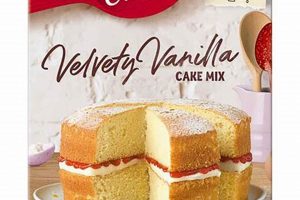
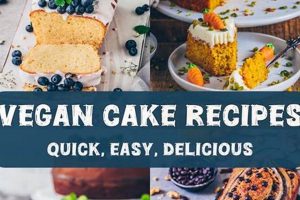
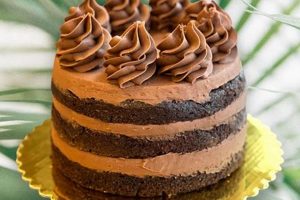
The process of modifying commercially available cake mixes to exclude animal-derived ingredients while retaining desirable qualities is the focus. This commonly involves substituting ingredients such as eggs, milk, and butter with plant-based alternatives like applesauce, plant-based milks, and vegan butter substitutes. For example, a standard yellow cake mix requiring eggs and milk can be transformed into a vegan product using these substitutions.
Employing this method offers several advantages, including convenience and accessibility. It allows individuals following a vegan lifestyle or with egg/dairy allergies to enjoy familiar baked goods without extensive recipe development. Historically, vegan baking required specialized knowledge and ingredient sourcing; utilizing modified mixes simplifies the process, making it more attainable for a broader audience.
The ensuing discussion will detail specific techniques and ingredient options for successfully converting conventional boxed cake mixes into satisfactory plant-based desserts. Considerations regarding texture, flavor, and structural integrity will be addressed to ensure consistent and appealing results.
Essential Conversion Strategies
Achieving optimal results when modifying pre-packaged cake mixes requires attention to detail. The following provides insight on techniques that ensure successful outcomes.
Tip 1: Egg Replacement Selection: Consider the functional role of eggs within the original recipe. Applesauce provides moisture and binding, while flaxseed meal mixtures contribute binding and a slightly nutty flavor. Commercially available egg replacers are formulated to mimic multiple egg functions.
Tip 2: Dairy Alternative Selection: Plant-based milks, such as soy, almond, or oat, can substitute for cow’s milk. Unsweetened varieties prevent excessive sweetness. Ensure the dairy alternative is at room temperature for optimal emulsification.
Tip 3: Vegan Butter Substitute Usage: Vegan butter substitutes often contain higher water content than dairy butter. Employing them in equal measure by volume may require adjustments to liquid ingredients to maintain proper consistency.
Tip 4: Mixing Technique Adaptation: Overmixing can develop gluten excessively, leading to a tougher final product. Employ a gentle mixing approach after liquid addition to avoid this outcome.
Tip 5: Baking Time Monitoring: Plant-based ingredients may impact baking time. Regular monitoring and toothpick testing are crucial to ensure the cake is fully baked without becoming dry.
Tip 6: Ingredient Temperature Considerations: Room temperature ingredients emulsify more readily, creating a smoother batter and more consistent texture. Take care to bring all ingredients to room temperature before combining.
Tip 7: Adjusting Liquid Ratios: As vegan butter substitutes often contain more water, consider reducing the amount of other liquids slightly to compensate. This prevents a soggy or underbaked cake.
Adhering to these strategies will increase the likelihood of a successfully converted cake, meeting both dietary restrictions and desired quality standards.
The next section addresses potential troubleshooting scenarios commonly encountered during the modification process.
1. Ingredient substitution efficacy

Ingredient substitution efficacy is paramount in the endeavor to modify commercially available cake mixes for vegan consumption. The success of “how to make vegan box cake” hinges directly on the appropriate and effective replacement of animal-derived components with plant-based alternatives. A poorly chosen or executed substitution will inevitably compromise the final product’s texture, flavor, and structural integrity. For instance, if applesauce is used as an egg replacement, understanding its moisture content is vital. Excessive applesauce can result in a dense, gummy cake. Conversely, insufficient moisture can lead to a dry, crumbly product. Thus, the efficacy of the applesauce substitution relies on both its selection and its precise measurement.
The importance of this efficacy extends beyond mere taste and texture. In instances where the original mix relies heavily on eggs for binding or leavening, achieving a similar outcome with plant-based alternatives requires careful consideration of their respective functional properties. Flaxseed meal, when prepared as a “flax egg,” can offer binding capabilities, while baking powder or baking soda, in conjunction with an acid, can contribute to leavening. Failing to adequately replicate these functions will result in a cake that lacks the desired rise and structure. Furthermore, the selection of plant-based milk alternatives, such as almond, soy, or oat milk, affects the flavor profile of the final product. Each milk possesses a distinct taste, and its interaction with other ingredients influences the overall palatability. Therefore, selecting the appropriate milk substitute is essential for achieving the desired flavor profile.
In conclusion, ingredient substitution efficacy is not merely a peripheral aspect of “how to make vegan box cake” but rather a foundational element that determines its overall success. Thorough understanding of the functional properties of both the original and substitute ingredients, coupled with careful measurement and precise execution, is crucial. The challenges inherent in this process underscore the importance of informed decision-making and methodical experimentation to achieve consistent, satisfactory results, linking directly to the wider theme of accessible and palatable vegan baking.
2. Moisture balance management

In the context of modifying pre-packaged cake mixes to exclude animal-derived ingredients, often referred to as vegan box cake, moisture balance management is a critical factor influencing the final product’s quality. The substitution of ingredients such as eggs and dairy products necessitates careful consideration of their moisture content, as these substitutions directly impact the cake’s overall texture and consistency. For instance, if applesauce replaces eggs, its inherent moisture may require adjustments to the liquid component of the recipe to prevent an overly dense or gummy texture. Conversely, the absence of dairy fats can lead to a drier cake if not properly compensated for with additional liquids or alternative fat sources.
The relationship between moisture balance and successful vegan box cake production stems from the original mix’s reliance on animal-derived ingredients for specific structural and textural contributions. Eggs, for example, provide both moisture and emulsification, while dairy products contribute fats that impart richness and tenderness. Removing these components disrupts the established moisture equilibrium within the recipe. The implications of inadequate moisture management are significant. An under-moisturized cake may exhibit a dry, crumbly texture and a shortened shelf life. Conversely, an over-moisturized cake may be dense, sticky, and prone to collapsing. Achieving the correct moisture level necessitates a deep understanding of the moisture contributions of all ingredients, both original and substitute. For example, if a mix calls for butter, a vegan butter substitute with a higher water content must be used cautiously, potentially requiring a reduction in other liquid ingredients.
Effective moisture balance management in this process is achievable through precise measurement, careful selection of substitute ingredients, and meticulous monitoring of the batter’s consistency during mixing. By adjusting liquid ratios and employing appropriate plant-based alternatives, the moisture content can be brought back into equilibrium, resulting in a cake that closely replicates the texture and mouthfeel of its non-vegan counterpart. Failure to recognize and address moisture imbalances directly compromises the quality and palatability of the resulting cake, highlighting the practical significance of this aspect of “how to make vegan box cake”.
3. Gluten development control

Gluten development control is a significant factor when adapting commercially available cake mixes for vegan preparation. Managing gluten formation is essential to attaining desired texture and structure in the final baked product, mirroring the characteristics of conventional, non-vegan cakes.
- Flour Composition
The protein content within the flour dictates the potential for gluten development. Cake flour, possessing a lower protein percentage compared to all-purpose or bread flour, minimizes gluten formation, resulting in a tender crumb. Substituting flours in “how to make vegan box cake” recipes can alter the gluten network, influencing the cake’s overall texture. Adjustments to mixing times may be necessary to compensate for varying flour compositions.
- Mixing Techniques
The degree and duration of mixing directly impact gluten development. Overmixing promotes excessive gluten formation, leading to a dense, tough cake. Vegan cake recipes may necessitate modified mixing approaches, such as gentle folding or short bursts of mixing, to inhibit gluten over-development. Understanding the interaction between mixing intensity and flour type is paramount for achieving a desirable crumb structure.
- Liquid-to-Flour Ratio
The quantity of liquid relative to flour influences gluten hydration and subsequent development. Insufficient liquid hinders gluten formation, resulting in a dry, crumbly cake. Conversely, excessive liquid promotes gluten development, leading to a gummy, elastic texture. Vegan cake recipes require careful calibration of liquid ingredients to optimize gluten hydration without encouraging over-development. Substituting liquid ingredients, such as plant-based milks, may necessitate further adjustments to maintain appropriate ratios.
- Additives and Inhibitors
Certain additives and inhibitors can modulate gluten development. Acids, such as lemon juice or vinegar, weaken gluten bonds, leading to a more tender crumb. Fats, including vegan butter substitutes, coat flour particles, inhibiting gluten hydration and formation. Incorporating these ingredients strategically can assist in controlling gluten development. Vegan cake recipes often leverage acidic or fatty additions to achieve the desired soft texture.
Effective gluten development control in vegan cake production requires a holistic approach, encompassing flour selection, mixing technique refinement, liquid ratio optimization, and strategic use of additives. Awareness of these interconnected factors enables consistent production of vegan box cakes possessing desirable texture and structure, analogous to conventionally prepared cakes.
4. Oven temperature calibration

Oven temperature calibration constitutes a critical, and often overlooked, component in achieving consistent results when modifying commercially prepared cake mixes to be vegan. Deviations between the oven’s indicated temperature and its actual internal temperature directly impact the baking process, affecting both the texture and structure of the final product. Incorrect calibration can lead to under-baking, resulting in a dense, gummy cake, or over-baking, producing a dry, crumbly texture. These adverse effects are amplified in vegan baking due to the altered ingredient composition, where the absence of animal fats and proteins necessitates precise temperature control to ensure proper gluten development and moisture retention. For example, a cake mix requiring a baking temperature of 350F (177C) may, in reality, bake at 325F (163C) in an improperly calibrated oven. This lower temperature extends the baking time, potentially drying the cake as moisture evaporates before the structure fully sets. Conversely, an oven running hot could cause the cake’s edges to burn before the center is adequately cooked.
The practical significance of accurate oven temperature calibration in “how to make vegan box cake” extends beyond merely avoiding undesirable textures. It is intrinsically linked to achieving optimal rise and even baking. Accurate temperature ensures the leavening agents, such as baking powder or baking soda, activate at the appropriate rate, leading to a uniform distribution of air pockets throughout the cake. This uniform expansion contributes to a light and airy texture, a hallmark of well-executed cake baking. Furthermore, consistent temperature promotes even heat distribution, preventing uneven baking that can lead to doming or cracking. The process of calibration typically involves using an oven thermometer to verify the internal temperature against the oven’s setting. If discrepancies are observed, the oven may require adjustment, either through user settings, if available, or professional servicing.
In summary, the relationship between oven temperature calibration and “how to make vegan box cake” is one of cause and effect. Inaccurate calibration introduces variability that negatively impacts the final product’s texture, structure, and overall quality. Regular calibration is therefore not merely a best practice, but a fundamental requirement for achieving predictable and satisfactory outcomes. The inherent challenges in vegan baking, arising from altered ingredient interactions, underscore the importance of precise temperature control, ensuring that the cake bakes correctly, resulting in a desirable texture and structure that meets the expected standard.
5. Baking time assessment

Baking time assessment forms an indispensable element within the successful execution of “how to make vegan box cake.” The inherent alterations to ingredient composition, specifically the substitution of animal-derived products with plant-based alternatives, directly impact the thermal conductivity and moisture retention characteristics of the batter. Consequently, relying solely on the baking time indicated on the original box mix instructions may lead to inaccurate assessments of doneness, resulting in either underbaked or overbaked cakes. For instance, substituting eggs with applesauce introduces higher moisture content, potentially extending the required baking time compared to a cake prepared with eggs. Conversely, the absence of animal fats, like butter, can alter the cake’s browning rate, leading to a seemingly cooked exterior while the interior remains underdone. The impact of these compositional changes necessitates a refined approach to baking time evaluation, relying not only on timer settings but also on direct sensory assessment of the cake’s physical properties.
The importance of appropriate baking time assessment in “how to make vegan box cake” stems from the direct relationship between baking duration and the cake’s structural integrity and textural qualities. Overbaking leads to excessive moisture loss, resulting in a dry, crumbly cake that lacks the desirable tenderness. Underbaking, on the other hand, yields a dense, gummy texture and may compromise the cake’s structural stability, causing it to collapse upon cooling. Examples include using visual cues such as surface browning and the insertion of a toothpick to assess the cake’s internal state. A toothpick inserted into the center of a properly baked vegan cake should emerge clean or with only a few moist crumbs attached. Furthermore, applying gentle pressure to the cake’s surface can provide valuable information; a properly baked cake will spring back lightly, indicating sufficient internal structure. Recognizing these signs and adjusting baking time accordingly is crucial for achieving the optimal balance of moisture and structural firmness. Accurate adjustments are essential for producing a palatable and visually appealing vegan cake.
In conclusion, baking time assessment is not merely a supplementary step in “how to make vegan box cake,” but rather a fundamental aspect that necessitates careful attention and refined sensory evaluation. The challenges arising from altered ingredient interactions underscore the importance of moving beyond reliance on conventional baking times and developing a nuanced understanding of the cake’s physical transformation during the baking process. Mastering these sensory assessment techniques enables the consistent production of vegan cakes that meet the desired standards of texture, flavor, and appearance. The intersection of ingredient modification and attentive baking time evaluation is essential for success.
Frequently Asked Questions
The following addresses commonly encountered inquiries regarding the modification of commercially available cake mixes for vegan consumption. These responses aim to provide clarity and guidance for achieving successful results.
Question 1: Is it possible to convert any standard cake mix to a vegan version?
While most standard cake mixes can be modified, certain mixes with specialized ingredients or unique formulations may present challenges. Successful conversion depends on the ability to effectively substitute animal-derived components with plant-based alternatives that maintain the desired texture and structure.
Question 2: What are the most reliable egg substitutes for this conversion process?
Several options exist, each offering distinct characteristics. Applesauce provides moisture and some binding. Flaxseed meal mixtures offer binding properties. Commercially available egg replacers are formulated to mimic multiple egg functions and often provide the most consistent results.
Question 3: Can plant-based milk be directly substituted for cow’s milk in a cake mix?
In most cases, yes. However, it is advisable to use unsweetened varieties to avoid excessive sweetness. Also, ensure the plant-based milk is at room temperature for optimal emulsification.
Question 4: Do vegan butter substitutes bake the same way as dairy butter?
Vegan butter substitutes generally contain a higher water content than dairy butter, which may impact baking time and texture. Monitoring the baking process and adjusting liquid ratios may be necessary to compensate.
Question 5: How does mixing technique impact the final result of a vegan box cake?
Overmixing can lead to excessive gluten development, resulting in a tougher cake. Gentle mixing after liquid addition is recommended to avoid this outcome.
Question 6: What adjustments, if any, are needed for baking time and temperature?
Plant-based ingredients can influence baking time. Regular monitoring using a toothpick is essential to ensure the cake is fully baked without becoming dry. Baking time may need to be extended or reduced, depending on the ingredient substitutions made.
Effective vegan box cake conversion requires a comprehensive understanding of ingredient properties and a willingness to adjust baking techniques accordingly.
The subsequent section will address specific challenges and potential solutions encountered during vegan cake baking.
Conclusion
This discussion has explored the intricacies of “how to make vegan box cake,” emphasizing ingredient substitutions, moisture management, gluten control, oven calibration, and baking time assessment. The successful modification of pre-packaged mixes necessitates careful consideration of these interconnected elements to achieve satisfactory results.
Mastery of these techniques enables consistent production of palatable, plant-based desserts. Continued refinement of vegan baking methodologies promises greater accessibility and broader appeal for individuals seeking animal-free alternatives. Further experimentation and ingredient innovation will likely yield even more successful adaptations of conventional baking recipes for vegan diets.